At ACEing Autism, every athlete starts in a different place. The goal isn’t to rush them toward a “right” way to play. It’s to figure out what works.
Rocky’s Growing Confidence
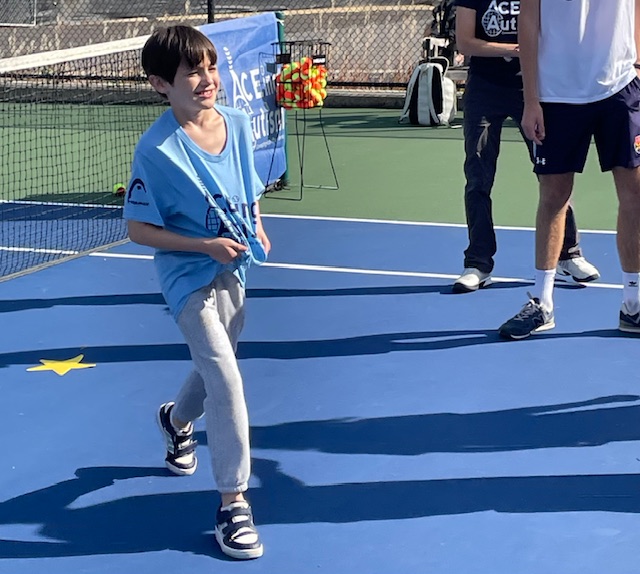
When Rocky, 10, first came to sessions, he stayed off to the side of the court with his volunteer. For much of the hour, he tossed a ball and “netted” it into his shirt.
Over time, he grew more comfortable and eventually picked up a racket. Rocky grips the racket head with both hands, using a technique that feels steady and controlled. With that approach, he soon completed a six-ball rally across the net.
“Rocky, once uninterested in tennis, now sprints up and down the court with racket in hand, smiling and waiting for me to toss the next ball,” his volunteer Ray told us.
Another of Rocky’s volunteers, Michelle, added, “Rocky is so sweet, energetic, and excited about playing with his friends! He’s got great eye-hand coordination — it’s exciting watching him progress to using the tennis racket. He has so much fun receiving the ball hit from Ray and hitting it forward to me.”
No longer content staying off to the side, Rocky now zips around the court, choosing different activities and playing with the other athletes.
Eli’s Love of Trick Shots
Eli, 12, plays on the same tennis courts. His path was a little different.
At first, he needed support to hold the racket. Eli began by throwing spot markers over the net, then moved to throwing tennis balls, eventually adding the racket with support.
“His love of trick shot games gave volunteers a fun way to help him progress at his own pace,” his mom, Luisa, shared with us.
After several years of steady practice, Eli now handles the racket independently and practices hitting balls across the net with other athletes.
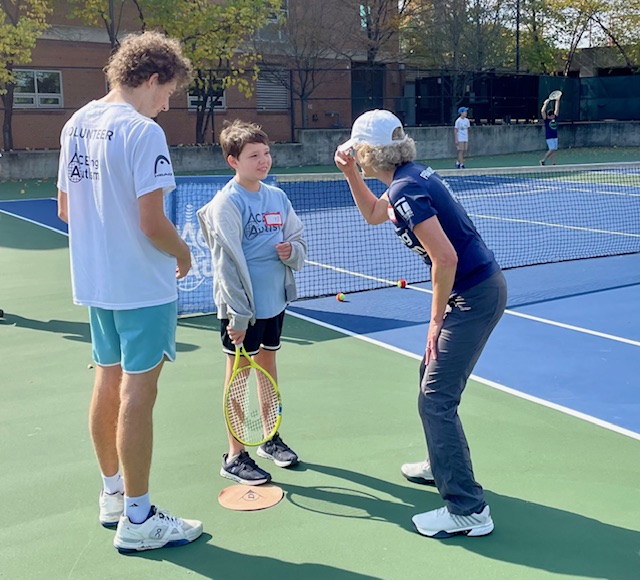
ACEing Autism athlete Eli with volunteers.
Built-In Flexibility
Both Rocky and Eli use alternative communication devices to express themselves. ACEing Autism is built with flexibility at its core, welcoming all forms of communication so every athlete can fully participate.
Adaptation is part of the structure. Volunteers adjust, athletes discover what works, and progress unfolds at its own pace. There isn’t one right way to hold a racket. There isn’t one timeline for growth.
A specialized curriculum, an intentional approach, and a committed community make it possible for thousands of kids each year to find their place on the court, just like Eli and Rocky.